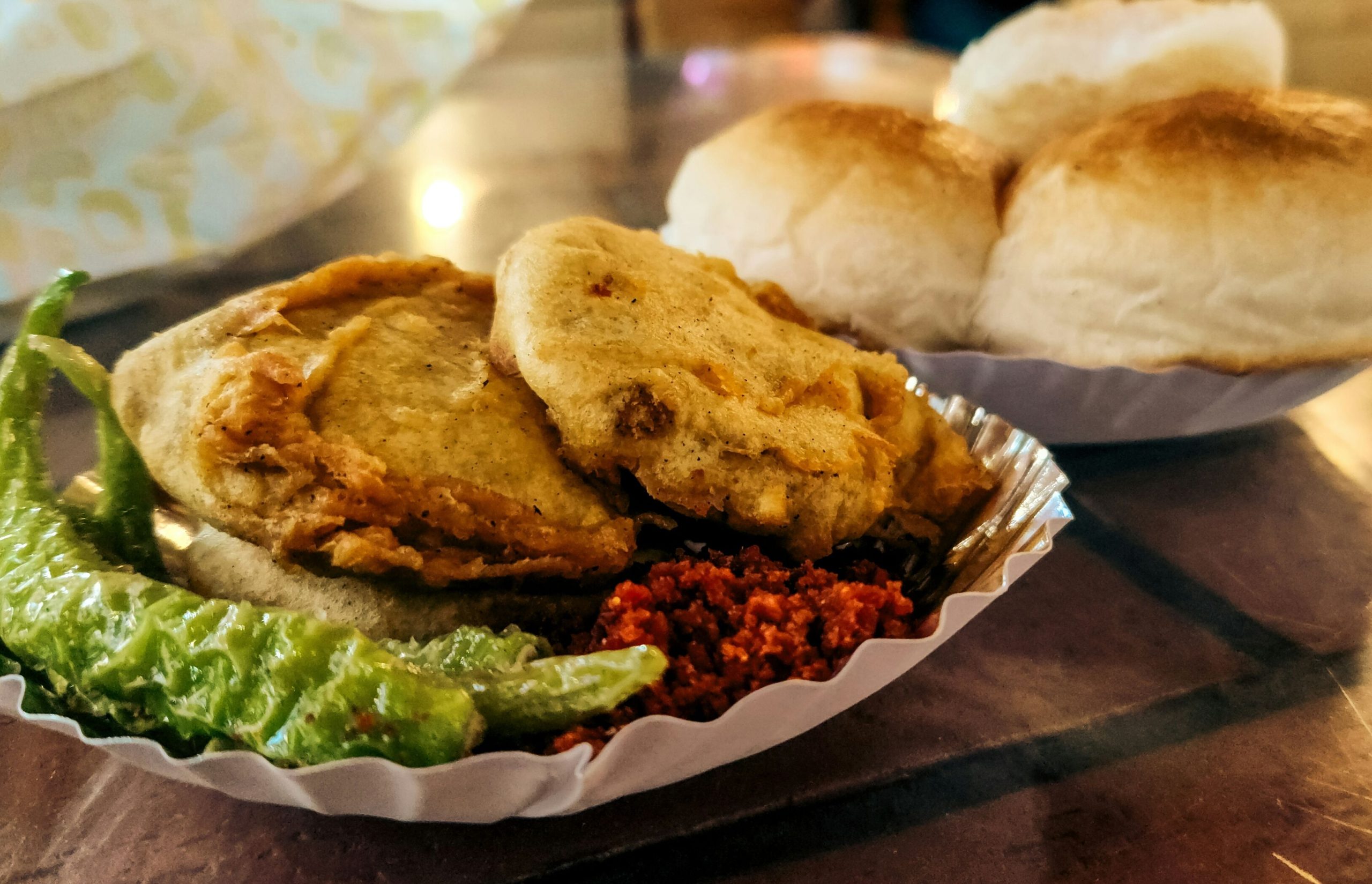
Introduction: The Rs. 15 That Feeds a City
If you want to understand Mumbai, do not go to Marine Drive at sunset. Go to any railway station at 8am and watch a thousand office-goers eat vada pav while standing, while running, while somehow managing to also check their phones and argue with someone on the other end of the line.
Vada pav is not just food. It is infrastructure. It is what keeps this city moving.
My first memory of vada pav is from Dadar station — age seven, holding my father’s hand, being handed a vada pav wrapped in old newspaper. The garlic chutney stained the paper orange. The vada was crisp on the outside and pillowy inside. The pav was slightly sweet. Together, they were perfect.
Every Mumbaikar has their vada pav origin story. Here is the recipe that comes closest to that memory.
Ingredients (Makes 8 vada pavs)
For the batata vada (potato filling): — 4 large potatoes, boiled and mashed (about 600g after mashing) — 2 tbsp oil — 1 tsp mustard seeds — 1/2 tsp turmeric — 8–10 curry leaves — 3 green chillies, finely chopped (adjust to heat preference) — 1-inch ginger, grated — 4 garlic cloves, grated — 2 tbsp fresh coriander, chopped — Salt to taste — about 1.5 tsp — Juice of half a lemon
For the batter: — 1 cup besan (chickpea flour) — 1/2 tsp turmeric — 1/2 tsp red chilli powder — Pinch of baking soda — Salt to taste — Water to make a thick batter — roughly 3/4 cup
For dry garlic chutney (the heart of vada pav): — 10–12 dry red chillies (Byadagi variety for less heat with good colour) — 1 full head of garlic (about 15 cloves), peeled — 3 tbsp dried coconut (kopra), grated — 1 tsp cumin seeds — Salt to taste
Green chutney: — 1 cup fresh coriander — 10 mint leaves — 2 green chillies — 1/2 inch ginger — 1 tbsp lemon juice — Salt to taste — 2 tbsp water to blend
Also needed: — 8 pav buns (ladi pav — the Mumbai kind, slightly sweet and soft) — Oil for deep frying
Method
Step 1 — Make the dry garlic chutney first (it keeps for 2 weeks): Dry roast the red chillies until slightly darker — 1 to 2 minutes. Remove. In the same pan, dry roast the coconut until golden. Let everything cool. In a mixer, blend chillies, garlic, roasted coconut, and cumin to a coarse powder. Do not add water. This must stay dry. Add salt. Taste. Store in an airtight jar.
Step 2 — Make the potato filling: Heat oil. Add mustard seeds and wait for them to splutter. Add curry leaves — they will crackle loudly, step back slightly. Add ginger, garlic, and green chillies. Cook 1 minute. Add turmeric. Add mashed potato. Mix everything well on low heat. Add lemon juice, coriander, and salt. Mix. Taste. It should be savoury, slightly tangy, with heat. Let it cool completely before shaping.
Step 3 — Shape the vadas: Divide potato mixture into 8 equal portions. Roll each into a smooth ball — the size of a large lemon. Set aside on a plate.
Step 4 — Make the batter: Mix besan, turmeric, chilli powder, baking soda, and salt. Add water slowly, whisking to avoid lumps. Batter should coat the back of a spoon thickly. If it drips off instantly, it is too thin — add more besan.
Step 5 — Fry: Heat oil in a deep pan to 180°C. Test with a drop of batter — it should rise immediately. Dip each potato ball into the batter, coating evenly. Lower into oil carefully. Fry 3 to 4 at a time. Turn occasionally. Fry until deep golden — 3 to 4 minutes. Remove and drain on paper towel.
Step 6 — Assemble: Slice pav almost through but not completely. Press open. Spread green chutney on one side. Add a generous layer of dry garlic chutney on both sides. Place one hot vada inside. Press gently. Eat immediately.
What Can Go Wrong
Batter falls off during frying: Either the batter is too thin or the oil is not hot enough. Test always before the first batch.
Vada is oily inside: Oil was not hot enough. The batter soaked oil instead of crisping instantly.
Filling is bland: You did not season properly. The potato must taste well-seasoned before frying because the batter adds nothing to the interior flavour.
Dry chutney is too hot: Use Byadagi chillies instead of regular red chillies. They give colour without punishing heat.
Pav is wrong: Supermarket bread rolls are not the same as ladi pav. Find an Iyengar Bakery or equivalent in your city. The sweetness and softness of real pav is non-negotiable.
The Mumbai Way
At the station stalls, the vada pav wala does something most home cooks forget — he butters the pav lightly before pressing it around the vada. That small amount of butter is what makes the difference between a good vada pav and a great one.
Also: eat it standing. Something about eating vada pav while seated at a dining table makes it taste 30% less authentic. Mumbai food is meant to be eaten in motion.